
New Zealand’s property market showed a steady hand through March, reinforcing a consistent theme seen in recent months. Despite ongoing geopolitical tension and rising fuel costs, the market continues to show resilience and stability.
The latest REINZ March 2026 Property Report highlights a market that is not retreating in the face of global uncertainty, but is instead adapting and holding firm. Previous oil crisis' have had varying impacts on the New Zealand Property market, as there are many factors at play. If there is one thing history shows its that rising oil prices are no reason to take your foot off the gas if you are looking at entering the property market.
March Market Snapshot - Stability in Action
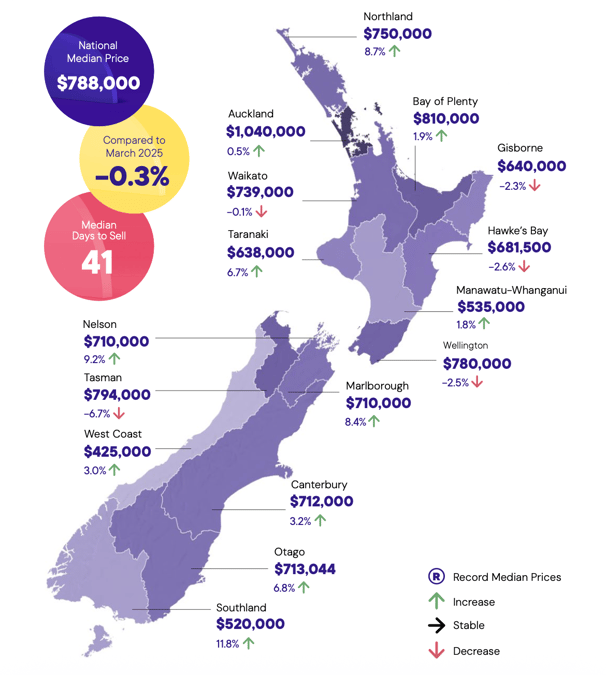
The March figures reflect a market that is balanced, active, and adapting. The national median price sits at $788,000, down 0.3% year-on-year, while outside Auckland prices increased 1.4% to $710,000. Sales volumes held steady at 7,853 transactions, reinforcing that activity has remained consistent despite global disruption.
Days to sell is sitting at 41 days, unchanged year-on-year and notably lower than February, while listing levels have barely shifted, and Inventory has increased modestly by 2.1%, showing there hasn't been a flood of new stock entering the market. What is particularly telling is that every one of these transactions occurred during the first full month of the Iran conflict. With petrol prices climbing above $3.30 per litre and consumer confidence waivering, buyers continued to act.
Regionally, the strength is clear. 11 of the 16 regions recorded price growth, led by Southland, Nelson and Northland. At the same time, the REINZ House Price Index remains around 14.9% below its previous peak, reinforcing that the market has already gone through a correction phase and is now stabilising.
A Market Defined by Cautious Confidence
The underlying theme across the market is cautious confidence. Shaun Taylor, Professionals New Zealand CEO explains “The REINZ statistics show what our businesses are seeing across our network; buyers remain active but more considered and sellers are realistic without being under pressure. Supply remains steady rather than surging. This is exactly what a stable and sustainable market looks like, driven by informed decision-making on both sides, rather than urgency.”
5 Impacts of the War on the Property Market - and Why They’re Less Severe Than Headlines Suggest
There is no doubt the conflict in Iran is influencing sentiment. However, when you step back and look at the fundamentals, the actual impact on the New Zealand property market is likely to be far less dramatic than many headlines suggest.
1. History Shows Property Markets Are Resilient
Historically, global conflicts and oil shocks have not led to consistent property market declines. Real estate markets are primarily driven by local conditions, not global headlines. In some cases, including the 1973 oil crisis and the Iraq War, property prices continued to rise in New Zealand.
2. Property Prices Are Driven by Fundamentals, Not Fuel Prices
Interest rates, migration, employment and housing supply continue to shape the market. Those fundamentals remain relatively stable in New Zealand, which is why the market is holding its position.
3. The Reserve Bank Is Supporting Stability
The Reserve Bank’s decision to hold the Official Cash Rate at 2.25% at its latest April review has helped maintain a level of stability in the market. While global factors such as rising oil prices may influence inflation in the short term, the Bank is expected to continue taking a measured approach, carefully balancing inflation pressures with the broader health of the economy.
4. The Market Has Already Been Through Its Correction
Property values are still sitting around 15% below their peak. That is significant. Markets rarely experience a second sharp downturn immediately after a major correction. Instead, they tend to stabilise and rebuild, which is exactly what we are seeing now.
5. A Persistent Housing Shortage Remains
New Zealand continues to face a structural housing shortage, estimated by some economists at around 40,000 homes. This creates a natural level of support in the market by underpinning demand and limiting downslide risk. Regardless of global events, people still need homes, and that demand remains constant.
The Bottom Line
REINZ’s March stats confirms what Professionals teams are seeing right across the country. As Shaun says “The market is stable. It is functioning, and importantly, it is showing quiet strength. Yes, buyers are taking more time as it is a buyers market. Yes, global uncertainty is influencing sentiment. But the fundamentals remain intact. As we move through the coming months, those who understand the market, rather than react to headlines, will be best placed to make confident decisions.”
As always, real estate is local. While national and global trends provide context, the best decisions are made with local knowledge. If you’re thinking about your next move, talk to your local Professionals team; they understand your market, your community, and how to position you for the best possible outcome.