
New Zealand’s housing market remains stable overall, but the pace of activity has slowed as buyers and sellers adjust to OCR changes, economic uncertainty, and a looming election, as Shaun Taylor CEO says “the economy has been remarkably resilient, the GDP results this week for the second quarter show continued growth, employment numbers are steady, and all economists are picking growth going forward, but also further increases in the OCR due to inflation. History tells us that when the economy is stable and growing the property market follows. Now is the time to buy, prices and mortgage rates are likely to be at their lowest for the next 7-10 year cycle.”
The latest REINZ data for August shows the national median sale price was $750,000, down 1.3% from August last year. The House Price Index, which provides a broader measure of changes in property values, was down just 0.9% year-on-year. These are modest movements and reinforce the view that values are generally holding rather than falling sharply.
The latest REINZ data for August shows the national median sale price was $750,000, down 1.3% from August last year. The House Price Index, which provides a broader measure of changes in property values, was down just 0.9% year-on-year. These are modest movements and reinforce the view that values are generally holding rather than falling sharply.
The bigger change is in activity. There were 5,430 sales during August, 13% fewer than a year earlier, while the median time to sell increased to 51 days. At the same time, the number of properties available for sale rose 9.7% to 32,908.
Together, these figures describe a market in which buyers have choice and time, but transactions are still taking place when the property and price align.
Shaun’s take on August’s property market data is similar to past statements. “I have said consistently this year that the national figures tell only part of the story. Conditions vary considerably between regions, towns and even neighbouring suburbs. Every South Island series in the REINZ House Price Index increased over the three months to August, while seven of the eight North Island series declined. The continued supply of new homes in Auckland holds down value and this skews the national figures as its more than a third of the market.”
These regional differences reflect local employment, stock levels, affordability and buyer demand. They also demonstrate why broad national headlines should never replace current local advice when making a property decision.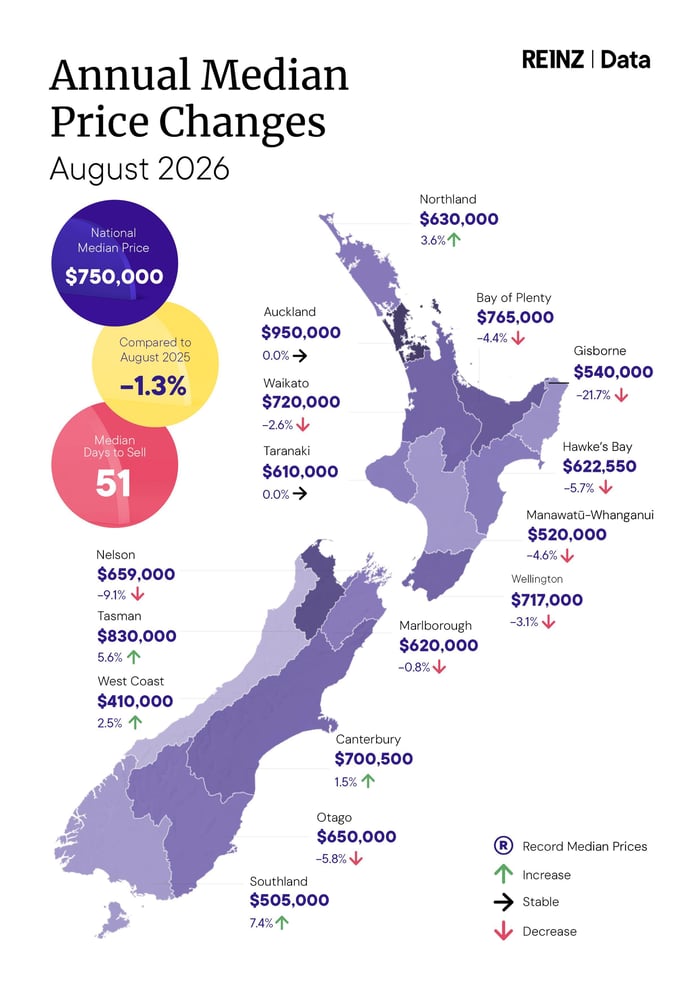 Interest rates are back in focus
The Reserve Bank increased the Official Cash Rate to 2.75% on 2 September. Inflation remains too high, so moving the OCR closer to a neutral level was widely expected. However, the Reserve Bank’s approach remains dependent on incoming inflation and economic data, and the next review is not until 28 October.
For homeowners, the immediate effect is less about the OCR itself and more about how banks price fixed mortgage rates. Several fixed rates had already moved higher before the announcement, reflecting changes in wholesale funding costs. Borrowers are responding by considering shorter fixed terms, which currently offer relatively competitive pricing and greater flexibility, although they also bring the risk of refixing at a higher rate later.
Interest rates will continue to influence confidence, affordability and the timing of decisions. But the current environment is very different from a distressed housing market. Employment has remained comparatively resilient, most owners are not under pressure to sell, and values are moving gradually rather than experiencing a widespread correction.
What this means for buyers
For buyers who are financially ready, the market continues to offer a valuable combination of choice, negotiating power and time to complete proper due diligence.
More stock is available, properties are taking longer to sell, and price growth remains subdued. That does not mean every seller will accept a heavily discounted offer. Well-presented homes in tightly held locations can still attract competition, and strong regional markets are behaving differently from weaker ones.
The opportunity is to make a well-informed purchase without the intense pressure that characterised the market at its peak. Finance approval remains important, particularly while mortgage pricing is changing.
What this means for sellers
Buyers are active, but they are selective and well informed. Sellers who achieve the best outcomes are those who understand the current evidence, present their property well and price it in line with competing homes.
Elevated inventory means buyers can compare properties carefully. An unrealistic launch price can cause a home to sit on the market, while a clear strategy supported by recent local sales can create momentum and stronger engagement.
The market is not frozen. People continue to move for work, family, lifestyle and financial reasons. The key is to meet the market that exists today rather than waiting for a rapid nationwide rise in values.
Looking Ahead
Spring should bring more choice and improved enquiry in many areas, although borrowing costs, job security, the general election and local supply will continue to influence confidence.
The most likely near-term outcome is a market that remains broadly steady, with regional variation and modest movement in values. That is not a market to fear. It is a market to understand.
Whether you are buying, selling or reviewing your options, speak with your local Professionals team for advice based on what is happening in your area now.